
When we read a piece of writing, we can consider it alone, separate and apart. But even if we view something as apart, it nevertheless is a part of a greater whole. This greater whole, in the context of any text, is referred to as its rhetorical situation.
There are a number of elements to the rhetorical situation of any text. We shall consider them here. Every element is interconnected, so the questions you will ask when examining each of them may be similar to another, only mirrored in terms of perspective.
Text
Any form of communication that humans create. The medium of communication itself is worthy to make note of, since a speech in front of an audience will come across differently than if it were published in a newspaper. Authors take this into account when writing, so in order to study their writing, you should too.
Ask:
- What is the medium of communication?
- How has the writer edited themselves, to take advantage of, or in light of, their chosen medium?
- Did the author choose this medium, or was it the only choice available to them at the time?
Context
All texts are created within the scope of their author's conscious understanding. When seeking to understand a text, the time, place, and any specific circumstances relating to its creation are of great importance.
Ask:
- Is there a specific occasion that called for the creation of the text?
- What specific cultural or historical event is the text connected with?
Author
Just as frequently referred to as the writer, the creator of a text presents a perspective shaped by a number of factors. Their background, their thoughts on the subject, as well as whether they have skin in the game (i.e. whether they have something to gain from presenting a particular perspective), should all be taken into account when studying a source.
Ask:
- Who is the author, and what does he know about the subject?
- What is the writer's relationship to the subject and to the audience?
- What values, ideas, and beliefs does the writer hold about the subject?
Audience
The indended audience of a text. An author might write very differently, depending on their chosen audience. And, the author has chosen their audience for a reason. Understanding this reason will be key to gaining an understaning of the text.
Ask:
- Who was this text written for?
- Why is the author addressing this audience, in particular?
- Based on your cultural knowledge, what values, ideas, and beliefs are likely held by the audience?
- Is the audience likely to be resistant to any values, ideas, or beliefs which the author holds on the subject?
Subject
What the text is about.
Ask:
- Is there anything about the subject matter which could be considered controversial? (Is dealing with it likely to cause offense to anyone?)
- Of what significance is the subject to the lives of the author and the audience?
Exigence
The exigence is what inspired the writer to produce the text. It could be anything - if the writer decided that a text was necessary, there must have been something which sparked or prompted that decision. Finding out, or even just speculating upon the exigence of the text can be a source of great insight when examining a rhetorical situation.
Ask:
- What motivated the author to create this text?
- What made it important for the author to create this text now, at this time?
Purpose
The purpose is what the writer wishes the text to do. It encompases both what the writer hopes the text itself accomplishes (that it presents an argument well, or that it starts a conversation on a given subject), and what the writer hopes will be accomplished through the text.
Ask:
- What is the straightforward purpose of the text? Is it to inform, to narrate, to persuade, or evaluate?
- Is there another possible purpose? Sometimes a text which appears on the surface to merely inform, may also prove to be persuasive...
- Why did the author choose to create this text for this particular audience?
Message
Whatever the text, to be worthy of study, it must include a central claim. The message of the text itself is the writer's claim, developed with reasoning and evidence. It is what the writer seeks to get through to the audience.
Ask:
- What is the writer's central claim?
- What idea does the author put forward, and support with evidence and reason?
Genre
What the audience expects from an author, when dealing with a specific subject matter.
Ask:
- What previous texts (relating similarly to the subject) have the audience likely been exposed to?
The elements of the rhetorical situation, and their relations between them, can be represented as a diagram:
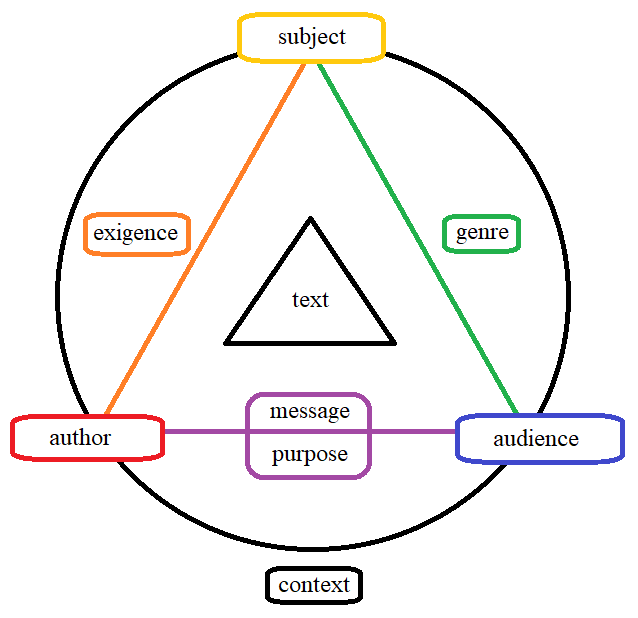
Take your time to understand each element and how it relates to the others. It may seem complex at first glance, but with some practice, you'll find that you can apply it to any text quite easily.
Once you're armed with the words to describe the elements of the rhetorical situation, we can begin to analyze the choices authors have made when creating texts. To practice, a variety of sources are provided below. Read each of them, and do your best to identify the author, audience, context, subject, exigence, purpose, genre, and message of each. A brief explanation about each text is provided, but independent reserach will mostly likely be required for your analysis.
Sources for rhetorical analysis:
A declaration presented by Tim Berners-Lee in 1996 outlines the background and details of his invention, the World Wide Web, which most people think of as "the internet" today.
An autobiographical essay published in the literary magazine Gangrel during the summer of 1946 describes, in broad strokes, the journey, thoughts, and intentions behind a storied writing career.
Onward to Analyzing the Rhetorical Situation.
Back to subject mainpage.